
India’s food and restaurant industry is evolving rapidly. With changing lifestyles, increasing urbanisation, growing disposable incomes and a strong preference for convenient dining, Quick Service Restaurants (QSRs) have become an attractive business opportunity for entrepreneurs and investors.
Table of Contents
ToggleThe Indian QSR market is projected to maintain strong growth, with convenience, takeaway, delivery and branded dining experiences playing an increasingly important role in consumer choices. Industry research also highlights the growing opportunity in Tier II and Tier III cities, where organised food brands still have significant room to expand.
For entrepreneurs looking to enter the food business, investing in a franchise can offer an important advantage: instead of building a brand, menu, operating system and customer base entirely from scratch, a franchisee can operate under an established concept with structured support.
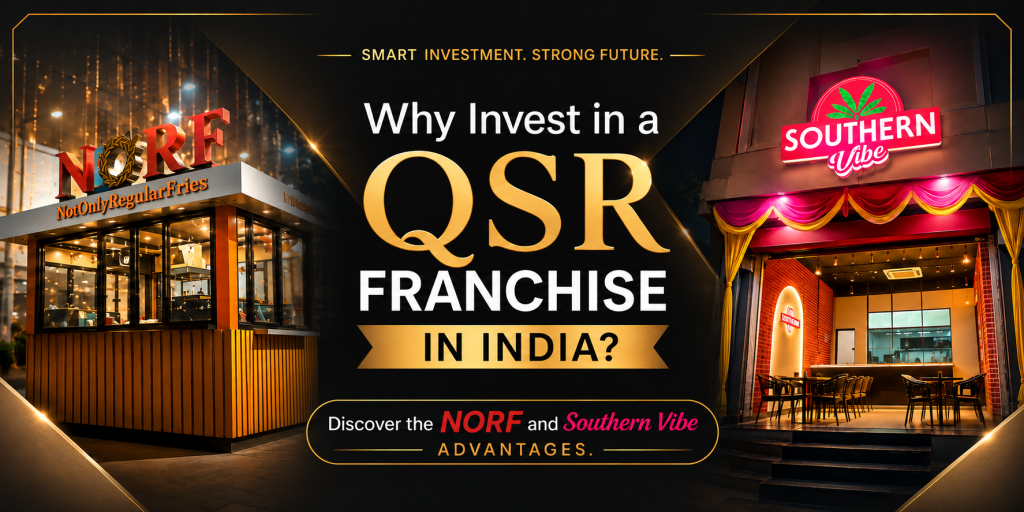
Among the emerging opportunities, NORF and Southern Vibe from the Sankalp Group offer two distinctly different QSR concepts—one focused on innovative, loaded fries and global comfort food, and the other on contemporary South Indian café dining.
Today’s consumers increasingly value food that is quick, convenient, consistent and easy to access. Office professionals, students, families and young consumers are all contributing to the demand for QSR formats.
QSRs can serve multiple consumption occasions—from quick lunches and evening snacks to takeaway meals, casual dining and food delivery.
This flexibility gives a well-planned QSR outlet the potential to serve customers throughout different parts of the day.
Building an independent restaurant requires developing everything from the ground up—brand identity, menu, recipes, SOPs, vendor networks, marketing and customer awareness.
A franchise model can provide a structured foundation.
With the right franchise partner, entrepreneurs can receive assistance with areas such as:
This can make the journey more organised, particularly for first-time food entrepreneurs.
One of the biggest strengths of the QSR model is its versatility.
Depending on the concept, outlets can be positioned in high streets, malls, food courts, commercial areas, office hubs, residential neighbourhoods and other high-footfall locations.
Southern Vibe, for example, identifies high streets, shopping malls, food courts, commercial complexes, office hubs, transit locations and premium residential neighbourhoods among suitable location formats.
The restaurant business can be rewarding, but it also comes with operational complexities. Food quality, staffing, inventory, procurement, customer experience and marketing all need to work together.
A franchise provides a tested business framework and brand ecosystem that can help simplify these areas.
However, investors should remember that no franchise can guarantee profits or ROI. Actual performance depends on factors such as location, rent, investment structure, local demand, operating costs, pricing, execution and customer retention.
The goal should therefore be to choose a concept with a strong market proposition, efficient operations and the potential to scale.
NORF—Not Only Regular Fries—is built around a simple but powerful idea: turning fries from a side dish into the hero of the meal.
The concept combines premium ingredients, bold flavours and creative recipes to create loaded fries, poutines, melts and other comfort-food experiences. NORF describes its menu as a combination of global inspiration and Indian flavours, offering options designed for customers looking for something familiar yet different.
Its positioning makes NORF particularly relevant to today’s younger, experience-driven consumers who enjoy discovering new food concepts.
1. A focused product proposition:
Instead of offering an extremely broad menu, NORF builds its identity around fries and loaded comfort food.
2. Global flavours with an Indian twist:
The menu takes inspiration from formats such as poutine and combines them with Indian flavour profiles and ingredients.
3. Multiple consumption occasions:
NORF is positioned for quick meals, evening cravings, casual hangouts, sharing with friends and family, and indulgent comfort-food occasions.
4. A contemporary QSR experience:
The concept is designed around quick service while maintaining focus on freshness, toppings, sauces, flavour and consistency.
For the proposed NORF franchise format:
The compact space requirement can make the concept suitable for entrepreneurs exploring smaller-format QSR opportunities.
ROI is an expected estimate and may vary depending on location, operating performance, investment structure and other business factors.
While NORF focuses on modern comfort food, Southern Vibe takes a different route by bringing authentic South Indian flavours into a contemporary café format.
Backed by the Sankalp Group, Southern Vibe is positioned as a modern South Indian café designed around speed, convenience, premium ingredients and consistent food quality.
South Indian cuisine has a strong and established consumer base across India, making the category attractive for entrepreneurs who want to participate in a familiar yet evolving food segment.
1. Established brand backing:
Southern Vibe is backed by the Sankalp Group, bringing the experience of an established hospitality business into the franchise concept.
2. Contemporary South Indian positioning:
The concept combines traditional South Indian flavours with a modern café environment and quick-service approach.
3. Operational support:
The franchise model includes business setup assistance, staff training, marketing support, operational guidance, SOPs, vendor assistance and ongoing consultation.
4. Multiple location possibilities:
The brand is designed for high streets, malls, food courts, commercial complexes, office hubs, transit locations and premium residential neighbourhoods.
The current franchise information lists:
The brand also states that franchise partners receive support covering areas such as site selection, outlet planning, setup, staff recruitment and training, SOPs, supply-chain support, marketing assistance and ongoing operational guidance.
*ROI is an expected estimate and actual results may vary depending on location, business performance, costs and other factors.
The two concepts target different opportunities within the growing Indian food-service market.
| Factor | NORF | Southern Vibe |
| Concept | Loaded Fries & Comfort Food QSR | South Indian Café |
| Investment | ₹12–15 Lakhs | ₹25–30 Lakhs |
| Expected ROI | 8–10 Months* | 12–15 Months* |
| Space | 200–250 Sq. Ft. | 1,000–1,200 Sq. Ft. |
| Positioning | Modern, indulgent, youth-oriented | Contemporary, authentic South Indian |
| Key Proposition | Global flavours + Indian taste | South Indian flavours + café experience |
| Suitable For | Compact QSR formats | Larger café formats |
The choice ultimately depends on your investment capacity, preferred business format, location, target audience and long-term expansion strategy.
The growing QSR market does not mean every restaurant concept will automatically succeed.
Recent industry performance shows that while major QSR chains continue to expand their store networks, same-store performance and margins remain important challenges. Rising commodity, logistics and operating costs are also putting pressure on the sector.
This makes the fundamentals of the franchise particularly important.
Before investing, entrepreneurs should evaluate:
A strong brand is important, but location + execution + unit economics ultimately determine the success of an outlet.
Both NORF and Southern Vibe are part of the broader Sankalp Group ecosystem, providing entrepreneurs with access to concepts developed within an experienced hospitality environment.
The Southern Vibe franchise model specifically highlights end-to-end assistance from planning and location evaluation through store setup, recruitment, training and launch.
For entrepreneurs, this type of structured support can be valuable because operating a QSR requires more than simply serving good food—it requires consistency, systems, people, procurement, marketing and customer experience.
India’s organised QSR sector continues to evolve. Consumers are becoming more comfortable with branded food outlets, digital ordering and delivery, while emerging cities are creating new opportunities for organised food brands.
A recent SEBI-filed industry document highlighted the expansion opportunity in Tier II and Tier III cities and noted the growing role of franchise-driven models, cloud kitchens and technology in the QSR sector.
This creates an interesting opportunity for entrepreneurs who want to enter the food-service industry with a scalable and professionally structured model.
Investing in a QSR franchise in India can be an attractive entrepreneurial opportunity—but the right concept matters.
If you are looking for a compact, differentiated and modern comfort-food concept, NORF offers a focused fries-led QSR proposition with a proposed investment of ₹12–15 Lakhs and a space requirement of 200–250 Sq. Ft.
If you are looking for a larger South Indian café concept backed by the Sankalp Group, Southern Vibe offers a contemporary South Indian dining format with an investment of ₹25–30 Lakhs and a space requirement of 1,000–1,200 Sq. Ft.
Both concepts represent different approaches to the same larger opportunity: building a modern, organised food business for India’s evolving consumers.
For an entrepreneur, the next step is to evaluate the location, investment structure, operating economics and target customer before making a franchise decision.
Ready to explore your QSR franchise opportunity?
Explore NORF for a modern fries and comfort-food concept, or discover Southern Vibe for a contemporary South Indian café franchise backed by Sankalp Group.
Copyright © 2026 Sankalp Recreation Private Limited. All rights reserved. | GST Number: 24AAGCS6661J3Z0
